
Letter to Congress · September 22, 2026 · Dallas, Texas
REO calls on the House to restore three repair protections before the floor vote
In a letter sent today to the House Energy and Commerce and Transportation and Infrastructure committees, REO asks the House to put back the REPAIR Act protections dropped from the Motor Vehicle Modernization Act.
At a glance
- REO sent the letter today to the House Committee on Energy and Commerce and the Committee on Transportation and Infrastructure.
- The letter supports Section 202 of H.R. 7389, the Motor Vehicle Modernization Act of 2026, which writes the 2014 and 2015 industry repair agreements into law and gives the FTC the power to enforce them.
- It asks the House to restore three REPAIR Act (H.R. 1566) protections the committee text dropped: no impairing repair, no blocking parts, and an FTC complaint process with a deadline to act.
- REO says it will meet these standards from its first truck and asks Congress to hold every manufacturer that sells in America to the same floor.
- Current highway and transit authorities expire September 30. REO asks that the repair title move with the protections intact, whether with the BUILD America 250 Act (H.R. 8870) or separately, and has offered to testify.
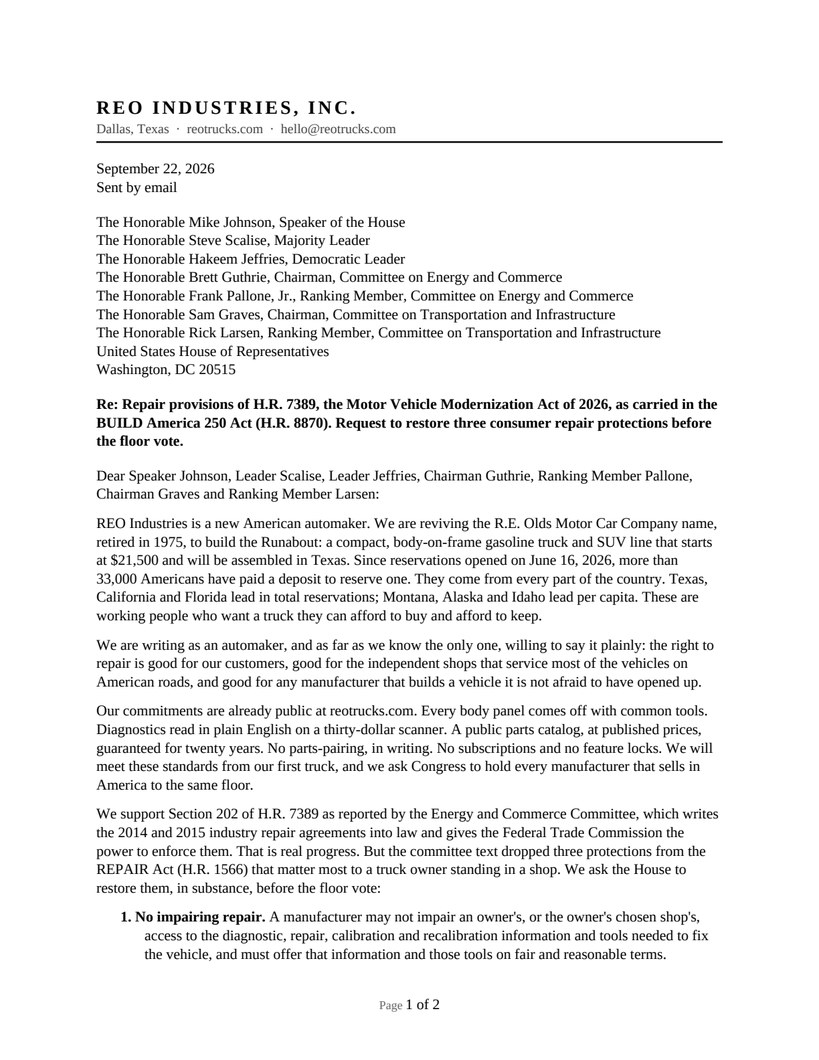
REO Industries has sent notice to the House Energy and Commerce and Transportation and Infrastructure committees asking that three consumer repair protections be restored to the Motor Vehicle Modernization Act of 2026 before it reaches the floor.
The letter, sent by email today to both committees, concerns the repair provisions of H.R. 7389 as carried in the BUILD America 250 Act (H.R. 8870). It is addressed to House leadership and to the chairs and ranking members of the two committees.
REO supports Section 202 of H.R. 7389 as reported by the Energy and Commerce Committee, which writes the 2014 and 2015 industry repair agreements into law and gives the Federal Trade Commission the power to enforce them. But the committee text dropped three protections from the REPAIR Act (H.R. 1566) that REO says matter most to a truck owner standing in a shop. The letter asks the House to restore them, in substance, before the floor vote:
- No impairing repair. A manufacturer may not impair an owner's, or the owner's chosen shop's, access to the diagnostic, repair, calibration and recalibration information and tools needed to fix the vehicle, and must offer that information and those tools on fair and reasonable terms.
- No blocking parts. A manufacturer may not use parts-pairing, serialization or software locks to prevent a compatible replacement part from working, whether that part comes from the manufacturer or from someone else.
- A place to complain, with a clock. An owner or an independent shop may file a complaint with the FTC, and the FTC must act on it within a set period.
“None of these provisions requires a manufacturer to redesign a vehicle. They require only that a company which sold you a truck not stand between you and the person you hire to fix it. Any automaker that objects to these three sentences should be asked to explain, on the record, why its customers cannot be trusted with their own vehicles.”
REO writes as an automaker, and as far as it knows the only one, willing to say plainly that the right to repair is good for its customers, good for the independent shops that service most of the vehicles on American roads, and good for any manufacturer that builds a vehicle it is not afraid to have opened up. Its commitments are already public: every body panel comes off with common tools, diagnostics read in plain English on a thirty-dollar scanner, a public parts catalog at published prices guaranteed for twenty years, no parts-pairing in writing, and no subscriptions or feature locks. REO says it will meet these standards from its first truck and asks Congress to hold every manufacturer that sells in America to the same floor.
Current highway and transit authorities expire on September 30. If the repair title moves with the BUILD America 250 Act, REO asks that it move with these protections intact. If it moves separately, it asks for the same. The company has offered to testify.
Since reservations opened on June 16, 2026, more than 33,000 Americans have paid a deposit to reserve a Runabout. Reservations remain open at reotrucks.com for a fully refundable $25.
Full text of the letter
Download the letter (PDF)September 22, 2026
Sent by email
The Honorable Mike Johnson, Speaker of the House
The Honorable Steve Scalise, Majority Leader
The Honorable Hakeem Jeffries, Democratic Leader
The Honorable Brett Guthrie, Chairman, Committee on Energy and Commerce
The Honorable Frank Pallone, Jr., Ranking Member, Committee on Energy and Commerce
The Honorable Sam Graves, Chairman, Committee on Transportation and Infrastructure
The Honorable Rick Larsen, Ranking Member, Committee on Transportation and Infrastructure
United States House of Representatives
Washington, DC 20515
Re: Repair provisions of H.R. 7389, the Motor Vehicle Modernization Act of 2026, as carried in the BUILD America 250 Act (H.R. 8870). Request to restore three consumer repair protections before the floor vote.
Dear Speaker Johnson, Leader Scalise, Leader Jeffries, Chairman Guthrie, Ranking Member Pallone, Chairman Graves and Ranking Member Larsen:
REO Industries is a new American automaker. We are reviving the R.E. Olds Motor Car Company name, retired in 1975, to build the Runabout: a compact, body-on-frame gasoline truck and SUV line that starts at $21,500 and will be assembled in Texas. Since reservations opened on June 16, 2026, more than 33,000 Americans have paid a deposit to reserve one. They come from every part of the country. Texas, California and Florida lead in total reservations; Montana, Alaska and Idaho lead per capita. These are working people who want a truck they can afford to buy and afford to keep.
We are writing as an automaker, and as far as we know the only one, willing to say it plainly: the right to repair is good for our customers, good for the independent shops that service most of the vehicles on American roads, and good for any manufacturer that builds a vehicle it is not afraid to have opened up.
Our commitments are already public at reotrucks.com. Every body panel comes off with common tools. Diagnostics read in plain English on a thirty-dollar scanner. A public parts catalog, at published prices, guaranteed for twenty years. No parts-pairing, in writing. No subscriptions and no feature locks. We will meet these standards from our first truck, and we ask Congress to hold every manufacturer that sells in America to the same floor.
We support Section 202 of H.R. 7389 as reported by the Energy and Commerce Committee, which writes the 2014 and 2015 industry repair agreements into law and gives the Federal Trade Commission the power to enforce them. That is real progress. But the committee text dropped three protections from the REPAIR Act (H.R. 1566) that matter most to a truck owner standing in a shop. We ask the House to restore them, in substance, before the floor vote:
- No impairing repair. A manufacturer may not impair an owner's, or the owner's chosen shop's, access to the diagnostic, repair, calibration and recalibration information and tools needed to fix the vehicle, and must offer that information and those tools on fair and reasonable terms.
- No blocking parts. A manufacturer may not use parts-pairing, serialization, or software locks to prevent a compatible replacement part from working, whether that part comes from the manufacturer or from someone else.
- A place to complain, with a clock. An owner or an independent shop may file a complaint with the FTC, and the FTC must act on it within a set period.
None of these provisions requires a manufacturer to redesign a vehicle. They require only that a company which sold you a truck not stand between you and the person you hire to fix it. Any automaker that objects to these three sentences should be asked to explain, on the record, why its customers cannot be trusted with their own vehicles.
Current highway and transit authorities expire on September 30. If the repair title moves with the BUILD America 250 Act, we ask that it move with these protections intact. If it moves separately, we ask for the same. Either way, REO would welcome the opportunity to testify.
Thank you for your work on this bill.
Respectfully submitted,
Zach De Bernardi
Founder and Chief Executive Officer
REO Industries, Inc.
9041 Garland Road, PO 2
Dallas, TX 75218
hello@reotrucks.com · reotrucks.com
cc: The Honorable Neal Dunn, The Honorable Marie Gluesenkamp Perez, The Honorable Brendan Boyle, and The Honorable Warren Davidson, sponsors of H.R. 1566
The Honorable Ted Cruz, Chairman, and The Honorable Maria Cantwell, Ranking Member, Senate Committee on Commerce, Science, and Transportation
The Honorable Ben Ray Luján and The Honorable Josh Hawley, sponsors of S. 1379
The Honorable John Cornyn and the Members of the Texas Congressional Delegation
About REO
REO is one of the oldest names in the American auto industry. Ransom E. Olds, the founder of Oldsmobile, began building REO cars in Lansing, Michigan, in 1905, and the REO Speed Wagon that followed in 1915 is widely considered an ancestor of the modern pickup truck. The company built vehicles in Lansing for seven decades, until 1975.
The REO brand returned in 2026. Based in Dallas, Texas, and led by founder and CEO Zach De Bernardi, REO is developing the Runabout, a lineup of simple, reliable and affordable trucks designed around right to repair and built to be driven, maintained and repaired for decades. The T4X work truck, T4C crew cab and S4C SUV share one body-on-frame platform and will be built in Texas. REO would like to thank the R.E. Olds Foundation, the R.E. Olds Transportation Museum and the REO Club of America for supporting the revival of this historic brand.
To learn more or make a reservation, visit reotrucks.com. Follow REO on Instagram at @drivereo and on X at @reoindustries.
Media contact
For all media information, images or interview requests: hello@reotrucks.com